
Save $1,000 on LASIK — Limited Time Offer. Spots fill in quickly! Schedule today to claim your savings →


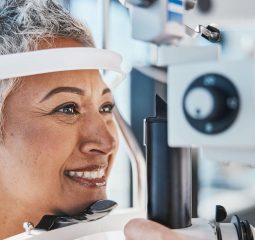
Have you noticed that reading menus, books, or your phone has become a daily struggle? Does it frustrate you to reach for reading glasses every time you want to see up close? Are you tired of battling your bifocals or multiple pairs of glasses to see all the important aspects of your life? If so, you’re not alone—this loss of near up-close vision is a normal, yet frustrating, part of aging. Alternatively, what if you could reclaim the freedom to see up close effortlessly, enjoy your life without glasses, and trust your eye care to one of Colorado’s most experienced vision correction teams all at the same time?
Refractive Lens Exchange (RLE) in Denver is a popular procedure for adults (usually 50+) who want to see young again for near up-close visual tasks. RLE is an eye procedure similar to cataract surgery, it is performed using an advanced premium intraocular lens (IOL) implant that is FDA-approved for cataract surgery.
RLE is for patients without cataracts. The eye doctor and the patient mutually decide if it would be beneficial to utilize this advanced, FDA-approved, premium IOL technology. In the case of RLE, the use is considered to be “off-label” to help patients without cataracts to see up-close without glasses. A comprehensive evaluation with an experienced vision correction specialist is imperative prior to making any decisions about having RLE.
At 20/20 Institute, we combine over 20 years of world-class vision correction outcomes with a 5-star, concierge-level patient experience. Our mission is to help you leave behind the frustration of glasses and rediscover the joy of clear, natural vision—delivered with the personalized care you deserve.
Have you ever wondered why reading up close becomes difficult as you age, or why you suddenly need brighter light and stronger glasses to see the fine print? The answer lies in a natural, progressive condition called Dysfunctional Lens Syndrome (DLS)—the underlying science behind the frustrating vision changes experienced by most adults as they age.
Dysfunctional Lens Syndrome is a term eye doctors use to describe the aging and loss of function in your eye’s natural lens. This lens, located just behind the colored part of your eye (the iris), is responsible for focusing light so you can see clearly at all distances. In youth, the lens is flexible and crystal clear, easily shifting focus from far to near—allowing you to drive, read, and enjoy life without visual effort.
Reading glasses, bifocals, or progressive lenses can help you compensate for these changes—but they don’t address the root cause: your lens itself is aging and losing its function.
DLS is a normal part of aging, not a disease or something you did wrong. It’s simply how the eye changes over time. The good news? Modern vision correction can now address DLS at all its stages, not just mask the symptoms.
Loss of Flexibility (Pre-Presbyopia):
Significant Loss of Flexibility and Some Loss of Transparency (Presbyopia):
Progression to Cataract:
Refractive Lens Exchange (RLE)—sometimes called clear lens exchange or lens replacement surgery—is a modern vision correction procedure that replaces your eye’s aging natural lens with a state-of-the-art intraocular lens (IOL). Unlike LASIK, which reshapes the cornea, RLE directly addresses the source of age-related near up-close vision loss.
RLE is similar to cataract surgery, which is performed approximately 4 million times per year in the United States. RLE patients do not have a cataract. However, they want to improve their near up-close vision. After a comprehensive examination and discussion, the doctor and the patients decide if it is beneficial for the patient to use the current FDA-approved cataract premium IOL technology for an “off-label” purpose of improving up close vision.
A personalized consultation is essential to determine if RLE is your best path to visual freedom. At 20/20 Institute, our transparent, patient-first approach ensures you receive honest guidance tailored to your unique needs.
Your comfort, confidence, and satisfaction are our top priorities.

Our dedicated doctors will help you choose the lens that best fits your lifestyle—whether you love golfing, reading, traveling, or simply want effortless, natural vision. The future of IOLs is bright, with ongoing advances in smart lens technology and AI-assisted customization.
Not sure which lens is right for you? Ask your Vision Counselor during your consultation.
The investment for RLE reflects the advanced technology, skill, and personalized care involved. In Denver, refractive lens exchange cost typically ranges from $5,000 to $7,500 per eye, depending on lens choice and complexity.
RLE is considered elective and not covered by insurance. Want a personalized cost estimate? Get your custom quote or ask about financing options today.
Tip: Follow your personalized recovery checklist and attend all scheduled follow-ups for the best results.
| Option | Corrects | Ages | Recovery | Pros | Cons |
|---|---|---|---|---|---|
| RLE | Near, far, astigmatism, presbyopia | 50+ | Days | Maximum freedom, UV protection, prevents cataracts | Intraocular, high cost |
| LASIK/PRK | Near, far, astigmatism | 18–60 | Days | Fast, on the cornea vs. inside the eye | Risk of Dry Eye, Need for readers at some point, not for thin or irregular corneas |
| EVO ICL | High myopia, astigmatism | 21–45 | Days | Removable lens. No Dry Eye, UV protection | Intraocular, not for presbyopia, more expensive than LASIK |
| Glasses/Contacts | Almost all Prescriptions | All | Instant | Non-surgical, UV protection in some cases | Ongoing hassle, ongoing cost |
RLE is typically best for adults 50+ with age-related vision changes, but suitability is determined individually.
Yes, but your eye will be numbed and you’ll be given a mild IV sedative to keep you comfortable throughout.
Many notice significantly improved vision within a day or two; recovery usually takes 1–4 weeks.
One eye is treated at a time for safety. However, in some cases, both eyes can be performed on the same day.
No—RLE eliminates the natural lens, so cataracts cannot develop.
We offer toric and premium toric lenses to correct astigmatism.
RLE is generally elective and not covered by insurance.
We’ll recommend the safest, most effective alternative for your needs.
Have more questions? Our Vision Counselors are happy to help.
I loved 20/20 Institute as soon as I walked through the door. They made me feel more than welcome and comfortable. They kept in touch…

Ready to see the difference for yourself? Schedule your free consultation today.

Schedule your personalized RLE consultation today—no obligation, just clear answers and expert guidance from Colorado’s Place for LASIK & Lens Surgery.
Speak to one of our Vision Counselors now at (720) 679-7133.
